
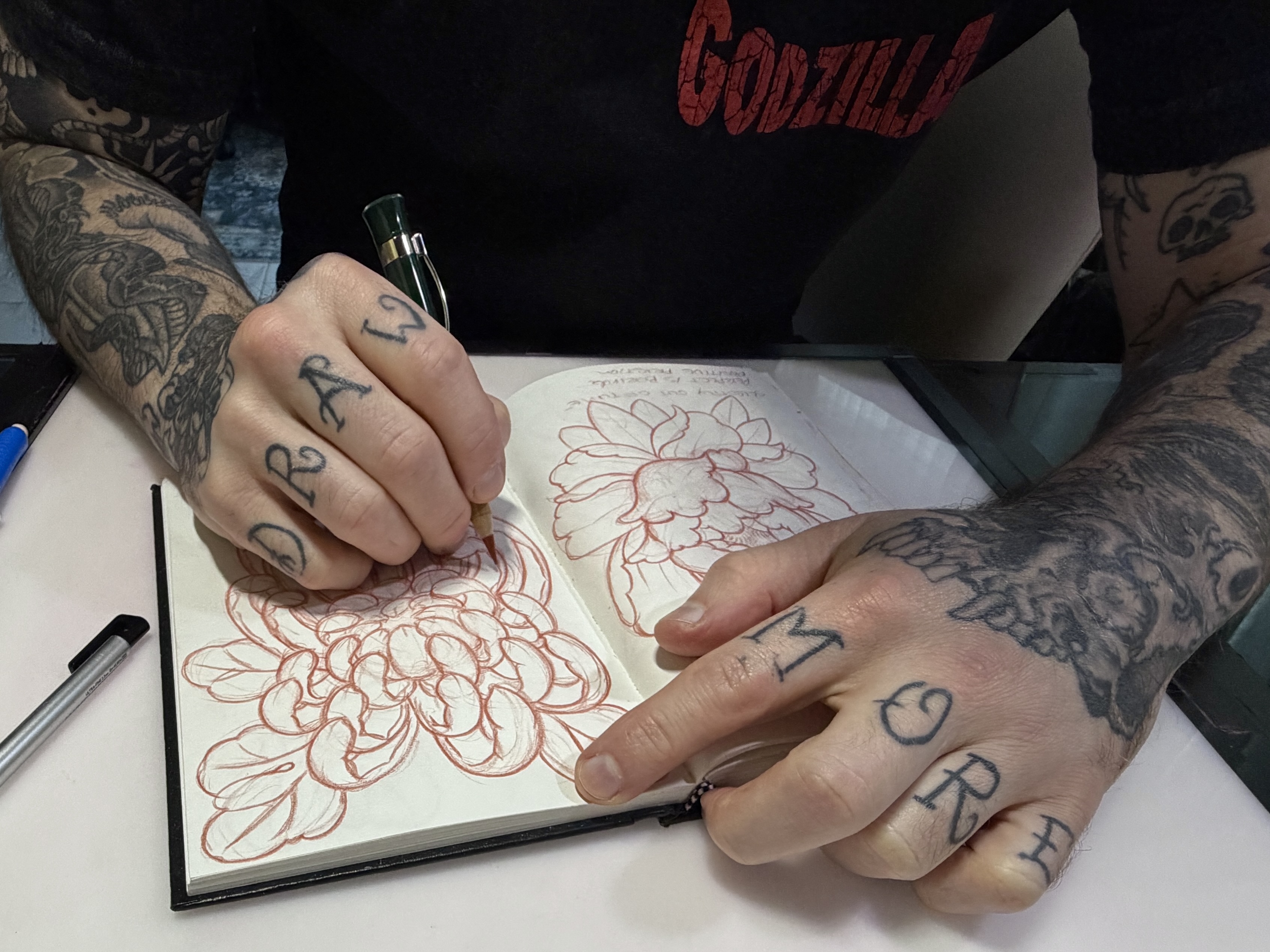
This post is from an interview between writer Theodora Sterling and tattoo artist Wesley Pretty for Substack.
Tucked away in the back room of Handmade Tattoo in Sherwood Park, Alberta, Wesley Pretty is hard at work setting up for our appointment. I’ve been seeing Wesley as my tattoo artist of choice for years now, and I love the quiet, personable, and methodical approach he brings to the artistry of tattooing. As a fan of his art, I’ve followed him closely as he’s grown and developed as a tattoo artist. I’m endlessly impressed by the wide range of styles he works in and his passion for the art form.
As he sets up, you can tell he’s performed this ritual countless times. Every step is efficient and deliberate. Before I know it, he’s donning his white nitrile gloves and herding me into position. With the two of us held captive by the delicate and painful work of tattooing, I take this as an opportunity to get to know Wesley Pretty better.


Back of the napkin
Name: Wesley Pretty
Creative Practice: Tattoo Artist
Location: Sherwood Park, Alberta, Canada
Coffee Order: Americano, Black
Where to find online:
- Instagram: wprettytattoo
- Website: wprettytattoo.ca
- Facebook: Wesley Pretty
I want to start by getting to know you as an artist. What drew you to tattooing?
I like the idea of being an artist who creates something that lives and breathes in the world. A tattoo isn’t tucked away in a bathroom or a hallway of someone’s house; it’s alive, and it dies. I also like that it’s a collaborative art form.
Tattooing also has its own distinct history. Sure, it’s lowbrow art, but it’s also the most dynamic and varied art form.
What keeps you coming back to tattooing day in and day out?
The clients, more than anything. The collaborative endeavour between artist and patron in tattooing is different than any other art form. Nothing is like it. I’m not just making art for them. I’m making art on them. Tattooing requires the patron to be present. It’s not like I’m away in a studio working on a portrait of their significant other, their pet, or something like that. They’re with me, through the good and the bad.
Do you think that client relationship and being able to be there with them through shitty moments and great achievements is also a part of the appeal?
Yes. But more so, there’s a struggle on both sides. I’m there for theirs, and they’re there for mine. I mean, in the design process, I’m alone, but the hard art form is the tattoo, not the design. I think it’s important to keep in mind that tattooing is a collaborative effort. And quite often, the collaborator is a non-artist.


Are you working on something specific right now? How is it going?
I’m doing more large-scale work now than I ever have in the past. I’m also dipping my toes into Japanese tattooing, which has an incredible learning curve. There’s so much to know, and depending on the type of Japanese tattoo you want to do, it can be a bit dogmatic. There are definitely some dos and don’ts and rules that can be bent but not broken.
Japanese tattooing is really blowing my hair back right now because it’s so challenging. I like learning new things, and there’s a lot to learn with Japanese tattooing, which is nice. I get bored if I’m not learning something new. It’s nice to have projects where you’re familiar with what you’re doing and very confident, but it doesn’t really spur growth. Unless you’re at least a little bit uncomfortable, you won’t grow.
Can you tell me what a typical creative day looks like for you?
I have two types of days: in-studio and out-of-studio.
When I’m out of the studio:
I wake up, drink coffee almost immediately, spend a little bit of time with my cat and then stare at my drawing table from across the room until I get the gumption to sit at it. Then it’s looking at reference, working on designs for current clients or for projects I want to do—designs that I put up for grabs. I like to have music, audiobooks, or movies on in the background. Then I usually start cooking around 3 or 4 pm for supper, and after eating, it’s either back to my drawing desk or spending quality time with my partner.
When I’m in the studio:
My day is the same. I get up and see off my significant other. I have a coffee or two. If I have any last-minute drawing to do, I’ll do it. I usually don’t draw at the last minute. I like to be prepared for my appointments at least 1-2 days in advance. But every once in a while, I’ll wake up the night before an appointment and have to start a piece from scratch because something will come to me, or I get a feeling about something and need to change it.
Once I’m out the door, I fight through traffic; I have a 40-minute commute. I’m usually at the shop by 9:30–10 am. Then I’ll clean my studio space, make sure it’s safe and ready for my client, and set up and prep my artwork. When my client comes in, we’ll chat about the design, then we stencil and start tattooing. Tattooing can take an hour, two, or six hours. Once the appointment is done and my client is bandaged and out the door, I clean up, get groceries from a locally run produce market (I’m vegetarian, so I like to get fresh vegetables multiple times a week, so there’s less waste), then head home and cook dinner. I do all the cooking.
If I were to say whether I have a hobby, cooking is definitely it. Drawing and art are not my hobby; it’s my livelihood.

Drawing and art are not my hobby; it’s my livelihood.
What part of the creative process do you enjoy most? Are there any parts that you struggle with?
Drawing. I love tattooing, but nothing is as satisfying to me as putting pencil on paper and the problem-solving that comes with putting designs together and bringing ideas to full development on paper.
Once upon a time, tattooing was so all-encompassing and challenging. Gaining experience and gaining the knowledge to tattoo things was once the most difficult part. Even though I’ve been drawing at a fairly high level since the ‘80s, drawing is still the most challenging, the most rewarding, all of those things.
Drawing is hard. I do everything by hand. I rarely use digital assistance like Procreate. But for the most part, everything I do is done with pencil and paper, and at size to fit my client. I’m not knocking other artists, but in my experience with my work, anything that’s done digitally doesn’t have the breath or energy that hand-drawn designs have. Something is lost in digital art.


Have you found that over time, recurring themes have emerged in your work or that you gravitate towards?
I tattoo what I’m hired to do. But the stuff I work on for myself is mostly organic: plants or animals.
I am also beginning to like and appreciate traditional subject matter in tattooing more and more. The tried and true designs, stuff that’s as old as modern tattooing or Western Japanese tattooing. I like that they’re all done slightly different. There’s variation on a theme, almost like the blues; there are all these old blues standards that have been redone and reinterpreted by so many different musicians. You become part of, not just the history, but a discourse that lives and breathes and changes and evolves with the art form. That’s a special thing to be a part of. It lends reverence to those who came before us.
Some people might think, “Oh, you’re copying an old design of another artist’s work.” To me, you’re actually reinterpreting it, and paying homage to it and keeping those things alive by tattooing them on new generations of people. I don’t think of it as flogging a dead horse or stealing. It’s a reinterpretation. The subtle, respectful evolution of these ideas is a really special thing to be a part of. It keeps the past alive.
What books, films, works, or artists have influenced you recently?
I’ve been looking at a lot of Japanese tattoos. I think the best way to learn is to look at the sources, at the tattoos that started traditional Japanese tattooing and the people who inspired those tattooers, like the artists and printmakers, the Ukiyo-e stuff. I like looking at the history and then reinterpreting the source material.
People like:
- Hokusai
- Hiroshige
- Kuniyoshi
What’s something that would surprise people about you?
Lots of people think I’ve been tattooing for a long time. I got a very, very late start at tattooing. I didn’t pick up a machine until I was almost 40 years old. Art has been a priority in my whole life. But tattooing, I didn’t start working in the medium until I was much older. So there was no screwing around. I couldn’t afford not to take this seriously from square one. I was about 41 when I started doing this full-time, and you know, at that stage of life, you have bills and responsibilities.
I had to work hard right from the very first moment I went full-time. Being able to do this on weekends while working all week wasn’t an option. Early on, I worked 100 days straight without a day off, and you can only keep that up for so long when you’re not 25. So I couldn’t just dip my toes into tattooing.
How’d you get started in tattooing?
Initially, I didn’t have aspirations to do professional tattooing. In 2020, I was in an emotional low period; my life was in an upheaval in my then-marriage, and even creatively as an artist. I actually, on a whim, started stick-and-poking myself, and I did some fairly nice tattoos. Then I went out and got a tattooing machine, looked for books by people who actually knew what they were doing, and I taught myself.
I was fortunate enough to be discovered by another tattoo artist who asked about my tattoos and invited me to come into the shop where he worked to get tattooed. After a while as a client, I got hired at that shop based on the tattoos I’d done on myself.
So I didn’t go the traditional tattoo apprenticeship route, and I’m not sure whether that worked out for me because of the depth I already had in the arts, or if I was just lucky. I try not to think about it too much. I wouldn’t recommend it as a way to learn tattooing. It’s a very complicated medium, and there’s a lot of safety involved. I practiced setting up and learned about cross-contamination and all sorts of things before I even started trying to tattoo myself with a machine.
It’s a blur when I think about it. Once I got into the shop, though, I was only self-taught for so long. I sponged everything up. I’ve always been able to learn by watching others, and seeing even the body mechanics of other tattoo artists helped me learn quickly. I was very lucky to work alongside some very talented artists from all walks of life, and lucky to be at that shop for the first 5 years of my career.


Thanks so much for tattooing me and sharing a coffee! One last question: if you could share a cup of coffee with anyone (living or dead), who would it be?
Hmm, this is tough. There are a lot of people I admire, but I don’t think I’d enjoy their company. Don’t meet your heroes, you know?
…William S. Burroughs.
Until next time…
Coffee Break is a new Substack interview series full of conversations with writers, artists, and creative minds about creativity, craft, and the stories behind their work. Thank you for pulling up a chair and joining us. Until next time, may your coffee stay warm and your notebook stay full!
Leave a Reply